04.24.26Lessons from the TLAC Math Workshop: Normalizing Error and Building Knowledge
In February, the TLAC team led its first-ever national Math-specific workshop in Houston, TX, where we joined math educators from around the country in a deep study of research-backed techniques for responding to error, building lasting knowledge through retrieval, and effective (re)teaching. Suffice it to say, it was a big success, and we learned a ton from the wisdom of the brilliant math educators and leaders that we got to work with—so much so that we are offering this workshop again in Memphis on June 29th-30th!
One of the biggest highlights from the workshop was how valuable participants found it when we directly connected the practical techniques we studied to principles from Cognitive Science. As one workshop participant shared: “The explanation of Cognitive Science principles were so valuable. I feel so much more enlightened to the rationale behind techniques, and am leaving with a deeper understanding of where, when, and why to implement these strategies.” We were happy to read this reflection because it speaks to one of our beliefs on TLAC, which is that when educators are equipped with a research-backed mental model for how students learn, they are well positioned to apply teaching techniques with greater intentionality, flexibility, and effectiveness.
One of the cognitive principles we unpacked during the workshop was the Law of Comparative Judgment, which states that humans are better at perceiving differences between two concrete examples vs comparing one example to an abstract standard. When learners are asked to compare minimally different examples, their working memory is better able to focus on small differences between them.
To illustrate the power of Comparative Judgment, Doug asked workshop participants to imagine that he was trying to teach them about the abstract idea of Sepia. One approach might be to show an image of a photo that is shown in the color Sepia (Approach A). Better still, one could imagine leveraging the Law of Comparative Judgment by showing a photo that is in the color Sepia, and comparing it with the same image in black and white (Approach B).
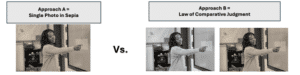
Upon reflection, workshop participants named that Approach B (Law of Comparative Judgment) would be more effective because it would give them a minimally different example to compare with the photo in Sepia. It both clarifies what Sepia is–and crucially–what it is not.
One of the many ways we’ve seen teachers apply this principle of Comparative Judgment is when they are using Show Call to respond to a common error. By Show Call, we mean the act of choosing a student’s paper and sharing it visually with the class so they can study it in a durable and sustained way. The law of Comparative Judgment comes into play when they Show Call not one, but two pieces of work–one that shows a correct solution and the other that contains a common error–and then prompts the class to evaluate which solution is correct and why. When learners are asked to compare minimally different examples, they are better able to make distinctions between them and more accurately assess their accuracy and quality.
At our upcoming workshop in Memphis, we’ll study several video examples of math teachers using Show Call in this way, including this great clip of Rose Bernunzio, a 6th grade math teacher in Rochester, NY.
As the clip opens, we see Rose check in with a student whose work she wants to Show Call. As Rose takes a piece of incorrect work, she tells the student that “lots of people are making this mistake.” She then reiterates this message as she reveals the work to the class. By naming that this was a common mistake, she makes error feel normal and natural, which in turn makes it easier for students to discuss it without shame or self-consciousness. Her goal is to emphasize that errors are an expected part of learning, without minimizing the fact that an error was made. Rose then visibly juxtaposes both solutions–placing one right right above the other–so students can easily compare them. Since Rose knows many students had difficulty with this question, she also directs their attention to the most salient differences between each response–the placement of important information—through the use of both verbal and nonverbal cues. Namely, she points out the parts of the response she wants them to attend to, and encourages them to “notice the information [Student A/B] placed inside the box.” We then see a few hands immediately go up before she has finished asking her question, but instead of calling on these students, she prompts them to compare both (“Who is correct and why?”). She then follows this with Wait Time. This ensures all students–not just who are the quickest to volunteer—have the opportunity to study both answers with her question in mind.
With the work still visible, Rose then sends students into a Turn and Talk, and in doing so further optimizes Ratio, or the proportion of the class that is grappling with her question. We then see the fruits of her decisions to leverage Comparative Judgment and add a Turn and Talk when she brings the class back together and nearly every hand goes up. Students are ready to dig into the discussion because they’ve been given the time and space to grapple with the work.
Throughout their discussion of the work, Rose prompts students to not only explain who is correct (Student B), but also why Student A is incorrect. In doing so, Rose is fostering what Cognitive Scientists refer to as positive knowledge (i.e. knowledge of how to do something correctly), which complements negative knowledge (i.e. knowledge of what is incorrect). This equips students not only with an understanding of where the error lies, but also how to fix it, so that ultimately they can avoid making the same mistake next time. With the support of the class, Rose makes live edits to Student A’s response, while strategically covering the parts of the work that she doesn’t want them to study yet. Ultimately, this Show Call results in students leaving with a correct solution or “Worked Example” that they can study and apply to a similar set of questions (parts b and c).
We hope you’ll join us in Memphis to learn from effective teachers like Rose and bring improved teaching and learning to your community.
 Cognitive Science, error analysis, Instructional Strategies, Law of Comparative Judgment, Math Instruction, Math Workshop, Mathematics Education, Normalizing Error, Pedagogy, retrieval practice, Rose Bernunzio, show call, Teacher Professional Development, TLAC, Turn and Talk