If you’ve already purchased a curriculum unit, please click below to subscribe to our digital platform and gain access to training and implementation resources.
Partner with us to bring your research-backed literacy curriculum to life. Together, we'll create a learning plan that drives your organization's literacy success.
Cognitive Science tells us that background knowledge is at least as important to reading comprehension as reading “skills.” Knowledge—of history, science, literary terms, vocabulary—is the chicken and the egg. Knowledge is the outcome of successful reading as well as the wellspring that feeds it.
Our approach to building and reinforcing knowledge is driven by the texts we read and aimed at building lasting knowledge. We infuse our lessons with relevant knowledge to support comprehension and deeper analysis of the texts we read in the curriculum. At the same time, we seek to build a strong base of knowledge that increases student understanding of important ideas and concepts that they are likely to encounter in the future, and we provide opportunities to encode that knowledge into long-term memory.
Vocabulary is an important form of background knowledge. Isabel Beck, author of Bringing Words to Life, tells us, “People with more extensive vocabularies not only know more words but also know more about the words they know. Depth of word knowledge correlates almost as strongly to reading as breadth of knowledge.” A knowledge based approach helps to build that depth which is why we incorporate Explicit Vocabulary instruction 2-3 times per week with ample opportunities for students to use and apply words in fun and challenging contexts. Additionally, we provide suggestions and support for Implicit Vocabulary instruction to support student comprehension during reading as well as create opportunities for kids to utilize previously taught words.
Writing is among the most important thinking work that students can do. It’s also among the most challenging tasks for students, and one of the hardest to teach. Strong lessons ensure that students learn to write to develop and refine their understanding of text. Our curriculum asks students to write—constantly—in three different ways:
Formative writing consists of exercises that let students use writing as a tool to develop and expand their thinking—to “think in writing.”
Developmental writing consists of exercises, embedded in the content of the reading, that seek to develop students’ syntactic control by focusing on craft at the sentence level. With this type of writing, students focus on how they express their ideas.
Summative writing asks students to form and develop short answer responses, paragraphs, or essays that explain and provide evidence for a more developed argument about the text.
Our units seek to put the text—and often reading the text with classmates—at the center of the lesson. One of the first things you’ll notice about our curriculum is that lesson objectives are text-driven: they describe what we want students to understand about the passage of text they are reading that day. Most likely you will never see the same lesson objective twice. They’re unique to each lesson because they are specific to the passage or text.
We think a great curriculum should be modular, meaning that a school or a teacher can choose from a variety of outstanding texts at a given grade level to assemble their own scope and sequence for the year. Our curriculum is built in roughly six-week units, and schools can purchase one unit or as many as they wish.
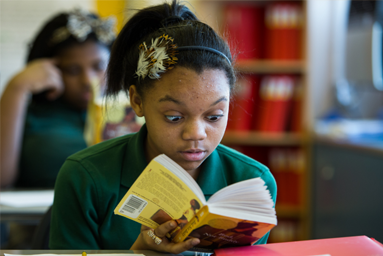
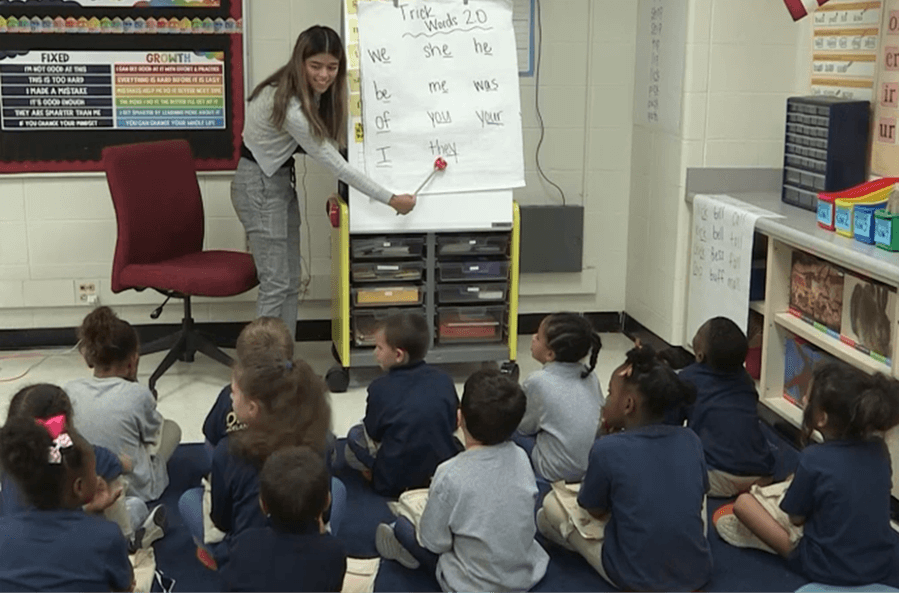
We ask students to read texts in three different ways: Accountable Independent Reading (silent, autonomous reading), FASE Reading (shared reading in which both students and teachers own the voice), and Read Aloud (teachers reading texts out loud). Reading, we believe, competes with other forms of media for students’ attention and interest. Using these three ways in balance supports students in building and practicing fluency while at the same time creates a positive culture around reading and books. FASE and Read Aloud are especially important to us and represent a departure from many curriculums. Students hearing their teacher and peers read out loud with strong fluency and expressiveness is critical for building fluency and connects them to the idea that the book is relevant and worthwhile, and the act of reading (especially when shared) is joyful.
We provide a variety of different types of professional learning opportunities to support teachers and leaders in their implementation of the Reading Reconsidered Curriculum. Our professional learning sessions are led by curriculum writers who offer practical guidance and support, using video and practice, to ensure the best possible literacy outcomes for students. We offer both in-person and remote sessions.
Choose the novels you want to read with your students.
Grade 5
Lexile Level: 770 – 1080
Wonder by R.J. Palacio (790)
Where the Mountain Meets the Moon by Grace Lin (810)
Number the Stars by Lois Lowry (670)
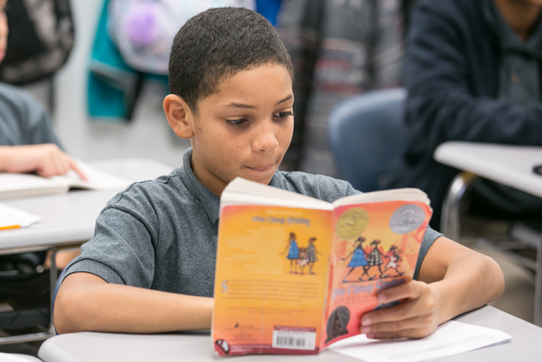
One Crazy Summer by Rita Williams-Garcia (750)
Inside Out and Back Again by Thanhha Lai (800)
Bud, Not Buddy by Christopher Paul Curtis (950)
A Single Shard by Linda Sue Park (920)
The Magician’s Nephew by C.S. Lewis (790)
The Boy Who Harnessed the Wind by William Kamkwamba (860)
Grade 6
Lexile Level: 855 – 1165
Bomb by Steve Sheinkin (920)
Boy: Tales of Childhood by Roald Dahl (1020)
Brown Girl Dreaming by Jacqueline Woodson (990)
Chains by Laurie Halse Anderson (780)
Esperanza Rising by Pam Muñoz Ryan (750)
Freak the Mighty by Rodman Philbrick (930)
Heroes, Gods, and Monsters by Bernard Evslin (800)
The Birchbark House by Louise Erdrich (970)
The Giver by Lois Lowry (760)
The Outsiders by S.E. Hinton (750)
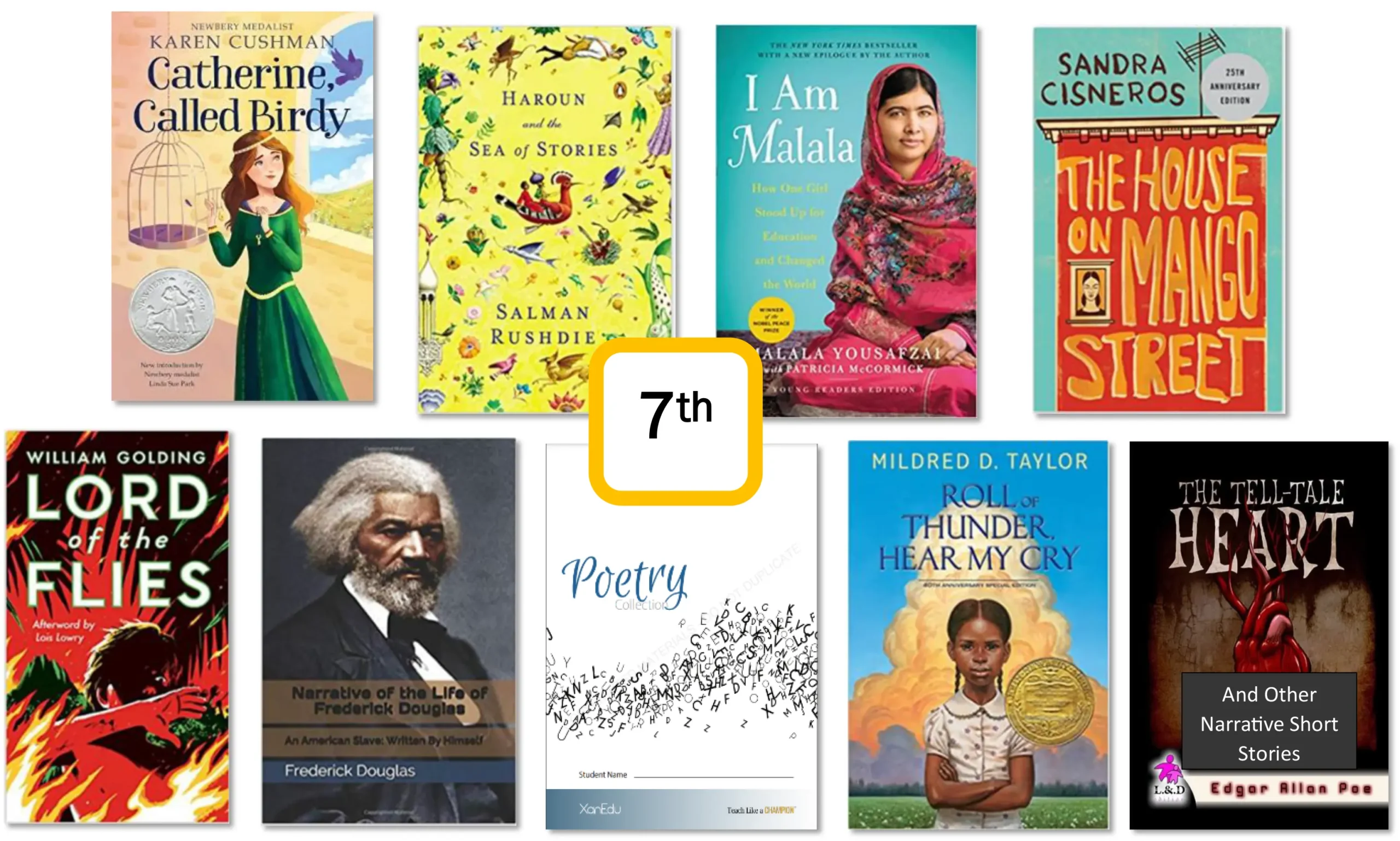
Grade 7
Lexile Level: 925 – 1235
Catherine Called Birdy by Karen Cushman (1170)
Haroun and the Sea of Stories by Salmon Rushdie (940)
I Am Malala: Young Reader’s Edition by Malala Yousafzai (830)
Lord of The Flies by William Golding (940)
Narrative Short Story Unit by various authors
Roll of Thunder, Hear My Cry by Mildred Taylor (920)
The House on Mango Street by Sandra Cisneros (870)
The Poetry Collection by various poets
Grade 8
Lexile Level: 985 – 1295
Animal Farm by George Orwell (1170)
A Raisin in The Sun by Lorraine Hansberry
Narrative of the Life of Frederick Douglass by Frederick Douglass (920)
Night by Elie Wiesel (590)
Of Mice and Men by John Steinbeck (1000)
Romeo and Juliet by William Shakespeare
Science Fiction Short Story Unit by various authors
The Wanderings of Odysseus by Rosemary Sutcliff (1220)
To Kill a Mockingbird by Harper Lee (790)
The Curious Incident of the Dog in the Night-Time by Mark Haddon (1090)
Future Development
MC Higgins, the Great by Virginia Hamilton (560) It’s Trevor Noah: Born a Crime by Trevor Noah (780) Fahrenheit 451 by Ray Bradbury (890)
GRADES 9-12
Of Mice and Men by John Steinbeck
Romeo and Juliet by William Shakespeare (coming 2026)
Fences by August Wilson (coming 2026)
We believe many of these books can be used at different grade levels than we have proposed and support your using them as you see fit. In several cases, we have proposed books at two levels because particular considerations (e.g., mature content) or opportunities for enrichment exist.
Samples
Click below to see examples from our One Crazy Summer unit.
Overview and day-by-day snapshot of the unit, including objectives and standards alignment
One-page study and reference tool of the key knowledge built over the course of the unit
Teacher-facing guide to the day’s lesson
Student-facing printable with writing space and embedded nonfiction
Videos
See teachers and students in action with the Reading Reconsidered Curriculum
Watch Christine Torres teach and practice Explicit Vocabulary with her 5th graders as part of the Number the Stars unit.
In this clip, Sarah Wright uses Turn and Talk and Cold Call to review a Do Now with her 6th graders during the Esperanza Rising unit.
During the Roll of Thunder, Hear My Cry unit, Hasan Clayton asks his students to make connections between the novel and a nonfiction article about the time period.
Training
We offer a variety of literacy training programs to support teachers across all grade levels, regardless of their current curriculum. We offer both in person and remote sessions. To see a full list of our workshops click here.
The Science of reading workship (formerly known as Reading reconsidered workshop)
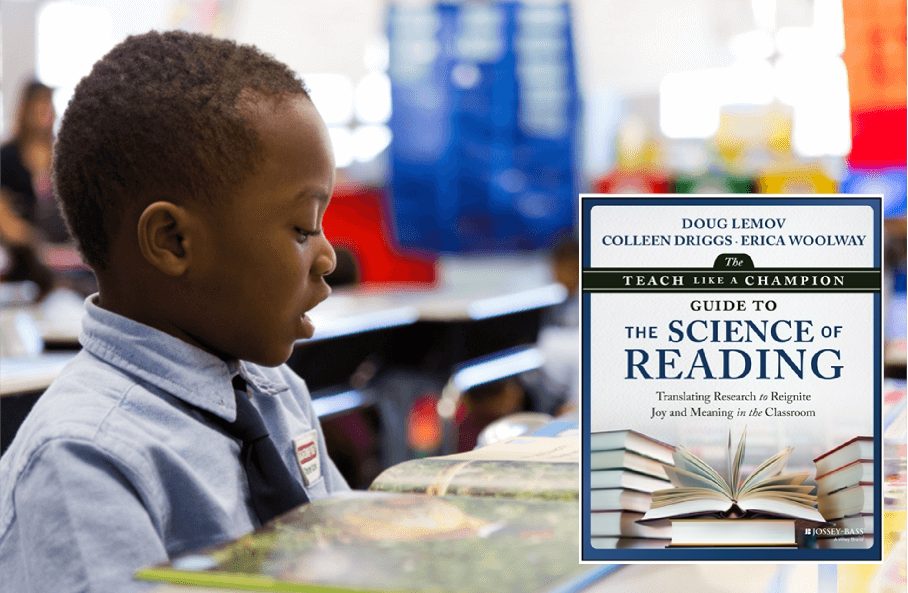
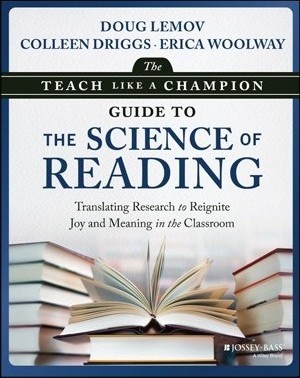
Let us train your staff using the newest guidelines from The Teach Like A Champion Guide to the Science of Reading. In this workshop we explore a variety of instructional techniques that support students in becoming college-ready readers. We’ll study the critical role of background knowledge and fluency, building attention, creating strong communities of readers through the three ways of reading, and the power of effective writing instruction in reading classes. Designed for teachers and leaders in grades 3-12, this workshop integrates video analysis, discussion, and practice.
“Hands down the best training I’ve been to. I have 8 supports that I can start implementing next week. I loved the way we were able to plan and then add to our planning after you presented your lessons.”
- Whittier Elementary School in Amarillo,Texas
“I loved all the videos and time to plan and practice!”
- Casa Grande ES in Casa Grande, Arizona
Foundational literacy workshop
In the Foundational Literacy workshop, the Teach Like a Champion Team will share our most up-to-date guidance on teaching techniques that support the implementation of strong reading programs in the early elementary grades. Focusing on best practices of planning, presentation, participation, and assessment, session attendees will have opportunities to plan for and practice explicit instruction in foundational literacy. Topics discussed include the science of word recognition, phonemic awareness and phonics drills, decoding in text, and fluency.
“One of the greatest strengths of this session was the exceptional modeling of segmenting and word recognition routines. The demonstration was clear, purposeful, and set the perfect foundation for learning. The way the session scaffolded from modeling into guided practice allowed us to build confidence and understanding step-by-step. The amount of time dedicated to authentic practice was incredibly valuable and ensured we could internalize the routines rather than just observe them. The precise and actionable feedback provided by facilitators during practice rounds was another highlight. Their feedback was targeted, supportive, and immediately applicable. Because of the way the session was designed and facilitated, we are leaving equipped to implement changes in our instruction tomorrow that will make a lasting impact on student learning.”
- ISD, Amarillo,Texas
“I love the modeling of how to teach each piece of the lesson and how to intervene during errors while keeping a safe classroom culture.”
- ISD, Amarillo,Texas
Literacy Lesson Prep Series
In this workshop, we will study our practical approach to bringing reading lessons to life while also deepening content knowledge. Participants will examine text preparation to create meaningful cycles of reading, prioritize lesson tasks and prepare for daily instruction, and practice responding to error and increasing student participation.
“Information was meaningful, purposeful and clear. Everything that was presented can contribute to a more engaging and effective reading class.”
- ISD, Amarillo,Texas
Literacy Consulting and Partnerships
Let us support your team in effectively implementing your research backed literacy curriculum. Together we will design and implement a learning and development plan that helps you meet your organization's literacy goals. Through our professional learning opportunities, participants analyze and practice techniques that support effective instruction and gain practical knowledge of the science of reading.
Phases of Implementation
Goals
Sample Supports
Launch Prior to the start
to build familiarity with the curricular resources and the science behind them
Professional development training (in-person or remote) direct to teacher and/or direct to coaches
District leader coaching and consultation
Initial Implementation Years 1-2
to build a shared vocabulary of and confidence with the pedagogical techniques that support strong implementation
Diagnostic site visits
Early bright spot cultivation
Professional development training
Innovation & Sustainability Years 2-Beyond
to provide customized coaching and support that helps schools meet the needs of all learners
Video Review Meetings
Site Visits
Leader & Coach Development
Not only did I gain valuable insight for myself through taping, which brought awareness and feedback from colleagues, but I was able (hopefully) to uplift and strengthen my colleagues as well through the meetings. Learning from TLAC staff who then also come to do in-person trainings meant I had continual access through relationships that built over time. BEST PD EVER.
- Middle School Teacher, Cleveland
Contact
We’d love to hear from you!
Interested in learning more, purchasing a unit, or have specific implementation questions? Please reach out to us at: