02.20.26“From Stilted to Smooth: A Practical Approach to Teaching Prosody” by Emily Badillo
When I was teaching 5th grade, I knew that I needed to support my students’ fluency, but I had no idea how to do it. I had some students who came into my classroom reading beautifully, with ease and comfort. Other students were still struggling to decode, requiring prompting with each challenging word. However, the majority of my students fell somewhere in the middle: their decoding was relatively accurate, but their reading still didn’t sound like natural speech. It was stilted or wooden or monotonous. It sounded effortful, despite its general accuracy. It felt like a chore—far from the joyful culture of reading that I wanted to develop.
My first instinct was to lean into character and expressiveness, channeling my inner theater kid and combing the text for dialogue tags I could use to prompt for more energy and expression. The text says Tree-ear speaks “eagerly,” can you try that again with an eager or excited tone? We just learned the vocabulary word “derision,” what might it sound like for Min to respond derisively to Tree-ear’s request? While this made reading more enjoyable, I’ve come to realize that it was a bit like cat nip – something that I was drawn to because it was easy and fun, but was likely not as impactful as it could have been.
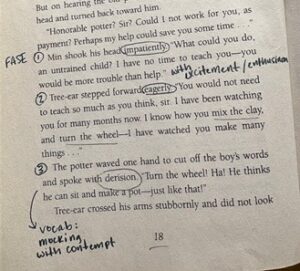
This approach helped a few kids, especially the ones who were excited to show a little dramatic flair, but in sections of the novel without dialogue or character emotion, we were stuck. And fluent, expressive reading of nonfiction? That felt impossible.
I realize now that I was over relying on expressiveness as a proxy for genuine fluency. As I’ve since learned, fluency consists of a combination of accuracy, automaticity, and prosody. While accuracy (meaning students’ ability to decode words correctly) and automaticity (fast, effortless word recognition, reflected in their reading rate) are relatively easy to hear and address, prosody can be more difficult. Prosody refers to reading that captures the rhythm and sound of natural speech. Tim Shanahan refers to prosody as “making the text sound like spoken language” but notes that this is still true when we read silently—the voice in students’ heads as they read silently should still be prosodic (consider the voice in your head as you read this post).
To become fluent readers, students need to hear models of fluent, prosodic reading and practice reading aloud with support and feedback. In our work with schools, we see many teachers who are still wrestling with what it looks like to praise or prompt for fluent reading beyond dialogue or character expression. Even as adult readers and listeners, fluent reading can be hard to describe or categorize. According to scholar Melanie Kuhn, prosody means “appropriate expression or intonation coupled with phrasing that allows for maintenance of meaning” and may include “variations in frequency or pitch, duration of vowels, stress on syllables, and pausing.” While it can be helpful to drill down into what makes prosodic reading sound the way it does, it’s not immediately applicable into our classrooms – try telling a 5th grader to maintain appropriate intonation coupled with phrasing!
Luckily, both teachers and students can hear and recognize fluent reading much more easily than we can describe it. The first step is to cultivate fluency (and especially prosody) in our own reading to students. One teacher we work with calls it her “radio broadcaster voice” and another channels her favorite narrator on Audible. These models are critical as we develop our students’ ears for fluent reading, and the more comfortable and familiar we are with our Read Aloud texts, the more fluent it will sound for students. Practice reading aloud at a rate that is slightly slower than you might typically use. Listen to the way your voice rises and falls to create emphasis. Where do you pause? What words do you stress? This preparation might feel unnecessary—we’re adult readers, surely we can read A Single Shard without practicing in the mirror first—but a few minutes of genuine practice out loud in an empty classroom can help us model the expert fluency that students need hear in order to hone their ear for text.
In class, we’ve seen a few additional useful approaches:
- Mini model and echo reading: After a student decodes a sentence, pause them, praise their accuracy, and ask them to listen to you model. Read the sentence yourself with slightly exaggerated prosody, then ask the students to try again and this time, mimic the model. (“Yes, you got every word! Let’s smooth it out—listen to me first. (Model sentence). Your turn, try again and match my voice”)
- Focus attention on a piece of syntax or punctuation: Either before students read or in response to what you’re hearing in class, lift up a significant piece of syntax or punctuation that you want students to listen for and practice reading aloud. This may mean teaching students to pause at commas, to drop their voices to read a parenthetical, or to read through an em dash as we see Jaime Johnson doing here. After a round of partner reading, Jaime projects a section of the text to draw students’ attention to the em dash in this sentence from the nonfiction text Bomb:
Everywhere he looked were incriminating papers—a plane ticket stub, a secret report, a letter from a fellow spy.
Jaime teaches students the name of this punctuation, explains that it means to pause, models reading the sentence, and has the class chorally read, all in about a minute of class time.
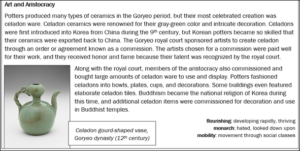
- Emphasize the pauses: One part of prosodic reading is dividing the text into meaningful chunks that reflect the punctuation and grammar of the sentences. If kids pause in appropriate places, it gives us important data on their comprehension and shows us how well they understand the construction of the sentence. Consider this sentence from the embedded text in our unit on A Single Shard:
Potters produced many types of ceramics in the Goryeo period, but their most celebrated creation was celadon ware.
Before reading, ask students to consider where they might pause while reading it out loud and model a pause at the comma before the conjunction. This attention to syntax also reinforces students’ language knowledge and helps them recognize how sentences work.
- Choral read: To practice the rise and fall of pitch, you might ask students to read as a whole group to attend to the way our voices change while we read. To ensure that the practice remains targeted, efficient, and effective, we recommend using this approach in short bursts, no more than a few sentences at a time.
If you’re interested in learning more about developing students’ fluency and other topics in the Science of Reading, we’d love to have you join us to learn more at our next workshop in Memphis on March 12-13th!
 Choral Reading, Echo Reading, ELA Strategies, Literacy Coaching, Literacy Instruction, Memphis Education Events, Modeling Fluency, Professional Development for Teachers, Prosody in Reading, Reading Fluency, Reading Phrasing and Syntax, Science of Reading, Sentence Decoding, teach like a champion, Teacher Workshops Memphis, Teaching Punctuation, Teaching Tips, TLAC