12.07.25Ask Doug: On Graphic Organizers
Doug recently got a note from a teacher in Texas who had read our recent book, The Teach Like a Champion Guide to the Science of Reading, and was especially interested in making social studies classes more writing intensive. This teacher was curious that we don’t show many graphic organizers in the book, unless blank spaces or T-charts (where students are asked to complete writing) count as organizers. I suppose they do count, in a way, but they certainly don’t look like these examples that schools might typically use:
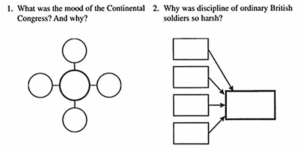
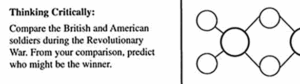
We thought we’d offer a short reflection on the topic.
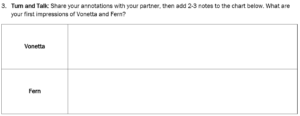
First, we didn’t leave them out because we think they’re bad. In fact, we think they can add value. A T-chart, a blank box with lines for writing, or a front the writing template absolutely counts as a graphic organizer in our view! Our book and our curriculum are full of them, like the one below.
We think intentionality and caution are worthwhile, though. Graphic organizers can be structured in a way that disincentivizes writing (for example, when graphic design concerns dominate over “Is there space to actually write?” concerns).
We might worry about that happening here:
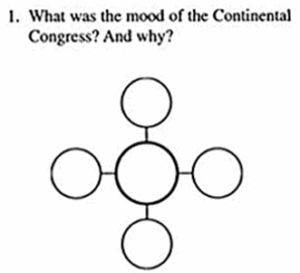
In other cases, the “connections” implicit in the diagram can limit the range of “relationships” students can perceive or conceive between ideas. Is it possible, for instance, that the diagram above causes students not to think? Consider the full, fleshed-out idea we want students to produce: “Lack of provisions combined with rampant sickness probably affected their mood and this was exacerbated by reports of privation at home while they were away during the harvest.”
For this reason, we tend to be in the “simpler the better” camp: leave lots of space for the writing to be fleshed out and explain the connections. Allow for students to describe those connections in flexible ways.
But those are pretty minor gripes. If the graphic organizer gets students thinking and writing, we say yes!
Ready to Go Deeper?
If you’re a content area teacher (like the Texas teacher who wrote in!) who wants to maximize the time your students spend immersed in reading and writing, join us for our brand new webinar: Literacy Across Content Areas.
In this three-session workshop, we will share the research from cognitive science and provide practical, replicable tools to help you integrate literacy principles into your subject.
Learn More & Register for the Literacy Across Content Areas Webinar. Sessions run Jan 26-30, 2026.
 Ask Doug, classroom instruction, graphic organizers, instructional design, lesson planning, Science of Reading, student learning, teaching