12.18.25For Coaches: An Update on Perception, Decision-making and Visual Search Behaviors
If you’ve read the Coach’s Guide to Teaching, you know how important perception is to decision-making, especially when a decision has to be made faster than about 5-6 hundreths of a second–which is how long it takes to think consciously. Basically a better athlete makes better decisions because his or hereyes are in the right place and looking for the most important things.
That said there’s more we don’t know about athletes’ visual search behaviors than we do, so how to use this information to design better training for athletes is a big question.
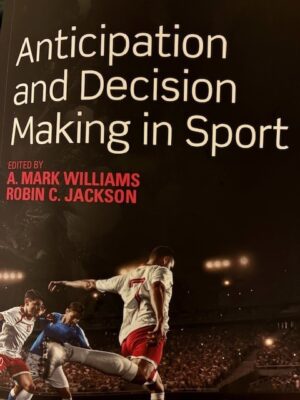
Try in to invest in my own knowledge I’m working my way through Mark Williamson and Robin Jackson’s book Anticipation and Decision Making in Sport and have found chapter 4, Visual Search Behaviors in Expert Perceptual Judgments, which is written by David Mann and colleagues to be excellent.
Here are some highlights:
- The big picture: Generally skilled athletes look at fewer things for longer compared to lesser athletes whose eyes are busier. (ie experts are experts because they know what to look at and fix on those things earlier thus gaining more information from the most important visual cues). But Mann et al point out, this may not always be the case. There may be cases where skilled athletes recognize the need to scan for more data points.
- “Skilled athletes typically use structured and systematic visual search patterns rather than merely random strategies.” [though they may not be aware of this] for example proximal to distal search. Or ball carrier to distant spot to ball carrier to opposite spot. A friend of mine reminds me of research that better defenders tend to orient their eyes toward the center of mass of a player with the ball rather than toward peripheral body movements (ie arms) and are thus less “fooled” by fakes and feints.
- They also point out that there is evidence that attention can be moved within a point of gaze, which makes peripheral vision relevant consideration”– “Point of gaze and locus of attention can be dissociated so that attention can be allocated towards the peripheral field and… players could covertly shift their attention towards different locations within the peripheral visual field by using a visual pivot, resulting in fewer fixations of longer duration” Although we should be aware of “the rapid reduction in the acuity of vision away from central vision means that there are significant limitations in the quality of the visual information possible using peripheral vision.”
- This suggests that gaze placement can be really important. i.e. as compared to gazing at a cue specifically “in dynamic situations that require tactical decisions” successful athletes often “attend to the most information-rich areas from the extensively distributed visual scene.” That is where you rest your eyes when you don’t yet know what to lock in on and the degree to which that spot is likely to maximize information is a second key factor in gaze behavior. So for example driving to the basket and being able to see both the basket and a teammate in the corner.
- They emphasize the very strong evidence for athletes using different gaze behaviors in different settings: predicting the flight of a ball versus the decisions of a player dribbling at you vs scanning a field to try to pick up potential threats. We know athletes changes and adapt different strategies for these situations but how they do so… well… not so much.
You might have seen this video (it’s in the book), where we see an expert and a slightly less skilled musician play with eye tracking glasses on. It captures a lot of the themes the chapter discusses: Beliavsky’s “structured and systematic visual search patterns,” the way both musicians change their search behaviors in different situations (playing from memory versus sight reading a new piece of music), the comparative steadiness of Beliavsky’s eyes compared to his student.
I’ve shown this to a lot of coaches and a lot of their questions about it are addressed in Mann’s chapter. Such as:
Does fitness level affect visual search? Probably: “Researchers have suggested that physical exertion can produce faster response times… in visual search tasks” and that “individuals with higher aerobic capacity performed a search task faster than those who were less fit.
Does anxiety affect visual search? Almost certainly: “high anxiety… resulted in fixations of shorter duration” in elite shooters and batters and that “anxiety slowed the anticipatory judgments of skilled football players, a change that was associated with increased mental effort and decreased number of fixation locations.” “The findings suggest that it is important to include anxiety in practice environments so that performers can learn to adapt to changes in gaze behavior that can occur in response to pressure.”
Does “context” help? Expert athletes combine contextual information (i.e. game knowledge of things like what is my opponent likely to do here?) with “kinematic” cues—(i.e. predictions about how a movement is likely to unfold based on early body cues from the opponent…e.g. oh, he’s going left here). But interestingly the data appear to be mixed on whether more contextual information helps athletes to make better information. The authors suggest: “It may be that contextual information that narrows the number of possible outcomes will induce more …predictive gaze strategies that are advantageous. However context that increases the number of possible outcomes could generate greater uncertainty and decrease performance by reducing the skilled performers ability to rely on predictive gaze strategies.”
They end by questioning whether there is a model of expert gaze or whether experts look differently. (surely there are differences but trends) and remind us that the constraints of research (much of it is done while watching video and describing reactions versus standing on a pitch and actually reacting) pose serious methodological challenges.
